PRODUCT INFORMATION / REVIEWS:
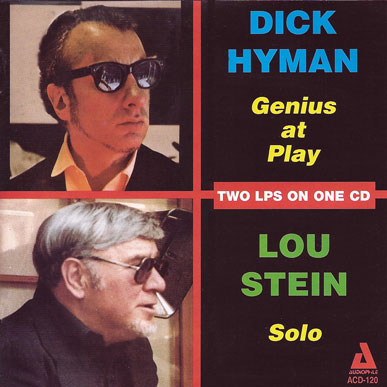
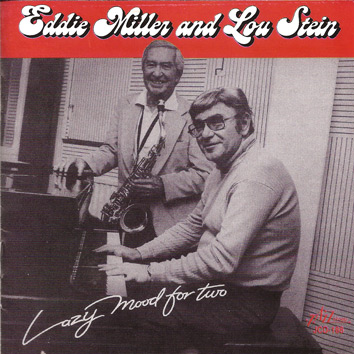
When I began seriously collecting older-style jazz records, in the early· 1950s at the dawn of the LP era, Lou Stein was one of the first pianists I listened to very much. At that time, he was at the keyboard for a series of fine sessions for Decca by The Lawson-Haggart Jazz Band which introduced me to many tunes associated with King Oliver, Jelly Roll Morton, The Original Dixieland Jazz Band and other immortals, all rendered in the Lawson-Haggart Chicago/mainstream mode, of course. Stein, then in his early thirties, had already acquired a formidable reputation as a jazzman, though not as a traditional jazz man. His fields were more in the swing and bop vein, having embraced work with Charlie Ventura (with whom he waxed "East of Suez," perhaps the best-known Stein composition), and Glenn Miller. ... Since then, during his long and productive career, Stein has maintained a broad-based, eclectic outlook toward music. His credits continue to include everything from classical works to free-wheeling jazz, as well as teaching at the college level. He has appeared in the company of such diverse hands as, to name a few, Bobby Hackett, Percy Faith, Charlie Parker, Benny Goodman, Coleman Hawkins, Andre Kostelanetz, Eddie Miller and Shelly Manne. Few musicians could hold their own amid such a kaleidoscope of artistic approaches. It's hardly surprising, then, that on this solo outing, Stein covers a wide spectrum of jazz sources. "Hindustan" dates from 1918, for example; in fact, one of its co-composers, Oliver G. Wallace, got the idea for the tune while accompanying a silent movie. "In A Mist" was written by Bix Beiderbecke, one of the brightest lights of the jazz age of the 1920s. George Gershwin and Jerome Kern, composers, respectively, of "Love Is Here To Stay" and "Yesterdays," are among the greatest names of the American musical stage. This same diversity shines through Stein's program, making it especially easy to take. "Hindustan" is a burst of pure energy, flashing like a lightning bolt across the first track. "Skylark" is exactly the opposite, a dreamlike, floating, ethereal ride through the clouds. "Yesterdays" offers a trace of that good old two-fisted stride during its first chorus. The romantic "In A Mist" is a relatively structured set-piece while "Skyscraper" is almost a free-form musical impression, its long passages on one minor chord evoking the building's impersonal facade while scurrying right hand lines conjure up the beehive of activity within. Thus, you will find a lot to like on this date. As long as I'm here, though, let me direct your attention to some aspects of Stein's playing that I find especially impressive. First, Stein always gives you a feeling of momentum, of forward movement, and he does so even though he frequently is not expressing the beat directly. For example, his introduction.s to several cuts involve vamps with a busy right-hand figure over a jab or two in the left, yet they bristle with rhythm and draw you irresistibly into the performance. Second, Stein's touch, even at its most delicate, has an underpinning of authority. He transmits a comfortable assurance that you're in the hands of someone who knows what he's doing and where he's going. Third, Stein never coasts, never seems to grope for ideas. Instead he keeps finding new ways to explore his material, getting a great deal into a few choruses, before, in many cases, wrapping it up neatly in a finale that echoes his initial statement. This striving for originality keeps your ear on your hi-fi, engages your intellect, and shows you some felicitous surprises, such as the funky, low-down barrel-housey setting for "Willow Weep For Me," about the meanest interpretation of this normally sophisticated and elegant 1932 ballad you'll find anywhere. These three characteristics--plenty of rhythm, a purpose in the execution, consistent creativity--are a sine qua non for a master jazzman. Lou Stein certainly qualifies, and if further proof be needed, give this album a spin. Tex Wyndham, May 1984. Tex Wyndham is himself a well-known pianist, in ragtime and revivalist jazz circles. He is a recognized authority on early jazz, having performed it at national festivals and on LP, and reviewed it for Mississippi Rag, The Second Line, Coda and other publications.
PERSONNEL
TRACKS
|
||